
Why the Pod Acceleration Framework™ matters when AI is moving faster than traditional Agile can handle

Most companies think the AI problem is adoption. It is not. The real threat is forcing AI through an operating model built for a slower world.
That distinction matters because many organizations are doing the same predictable thing. They buy copilots. They run pilots. They hold strategy sessions. They talk about transformation as if saying the word enough times will somehow modernize the business. Then they try to force AI into delivery systems built for slower cycles, heavier governance, and too many handoffs. The result is predictable. The tools move fast. The organization does not.
The future of work is not about layering AI on top of yesterday’s delivery model. It is about redesigning how work gets done.
Work is changing faster than most businesses are built to handle. Skills are shifting. Roles are evolving. Expectations are rising. Teams are already using AI in real work, often faster than leadership has built a clear model to guide it. That creates a dangerous gap between what technology makes possible and what the business is structured to absorb.
If organizations want real value from AI, they need more than access to tools. They need a delivery model that matches the speed, ambiguity, and opportunity of AI enabled work.
Why the old model no longer holds
Traditional Agile helped teams move faster than waterfall. That was real progress. But in many organizations, Agile became bloated over time. Sprints turned into rituals. Ceremonies multiplied. Dependencies piled up. Teams spent more time managing the process than improving the outcome.
That was already a problem before AI. With AI, it becomes a bigger one.
AI compresses the time between idea and output. Research moves faster. Drafting moves faster. Prototyping moves faster. Coding, testing, and refinement all move faster. When the surrounding operating model stays slow, the constraint becomes obvious. It is no longer the team’s ability to produce. It is the company’s ability to decide, govern, and absorb change.
Traditional sprint cycles are too slow for AI enabled delivery
A one- or two-week sprint was once seen as fast. In many AI driven delivery environments, it is already too slow. Teams now need to release, learn, and adjust in much shorter cycles.
That is why the Pod Acceleration Framework™ created by WinDon Dynamics, LLC compresses work into shorter execution loops. In the right context, traditional sprint timing is accelerated to 48 to 72 hours. This is not about recklessness. It is about reducing dead time, shortening feedback loops, and learning faster while the work is still fresh.
More output does not equal more value
AI can produce more in less time. That does not automatically mean the business is improving. If priorities are unclear, governance is late, and ownership is fuzzy, AI simply helps teams generate confusion at a much higher rate.
This is where many leaders get fooled. They see more activity and assume progress. In reality, they may be speeding up waste.
What the future of work really requires
The future of work needs a different operating model. One that assumes faster cycles, tighter collaboration, and more fluid interaction between business expertise, technical delivery, and AI assisted execution.
It also needs a model that treats professionals as central to the work, not incidental to the tooling. AI does not replace the need for judgment, architecture, prioritization, governance, or business context. It increases the value of those things.
The new requirement is speed with control
Organizations need a way to move faster without losing quality, accountability, or direction. That means:
- shorter release cycles
- faster decisions
- clearer ownership
- tighter business and technical alignment
- governance built into delivery, not dumped on top at the end
- rapid learning built into the execution model itself
The future belongs to teams that learn faster
The real advantage is not simply producing faster. It is learning faster. Teams that can test, observe, refine, and release in short cycles will outperform teams still waiting for the next planning ceremony to bless movement.
That is the shift. The future of work is not a tooling conversation. It is an operating model conversation.
What the Pod Acceleration Framework™ is
The Pod Acceleration Framework™ is a modern operating model built for AI development and implementation. The framework designed by the principles at WinDon Dynamics, LLC replaces slow, rigid delivery structures with small, accountable, cross functional pods organized around outcomes.
Each pod is designed to move with tighter feedback loops, clearer ownership, faster decisions, and measurable business impact.
At the center of the model is a simple belief. Speed alone is not enough. Teams also need clarity, discipline, and a way to solve the right problems in the right order. That is why the Pod Acceleration Framework™ combines pod-based delivery with Toyota Business Practice.
Small pods, clear outcomes, faster cycles
Instead of treating delivery as a long chain of handoffs, the Pod Acceleration Framework™ organizes work into smaller teams aligned to a real business outcome. These pods are built to move quickly, learn quickly, and adjust quickly.
They are not random project groups. They are focused delivery units with clear accountability.
Disciplined problem solving, not random motion
The framework starts by defining the Ideal Condition. What are we trying to achieve. What should the future state look like. What outcome matters for the customer, employee, or enterprise.
From there, the team assesses the Current Condition, identifies the most important gaps, analyzes root causes, and implements countermeasures in short cycles.
This matters because most organizations are not short on activity. They are short on focus.
Why AI changes the delivery equation
AI development is changing who can build and how quickly they can move. The work is no longer limited to traditional engineering teams writing every line manually from scratch. Increasingly, development is being shaped by professionals who know how to direct, refine, and control AI assisted workflows using tools like Codex, Claude Code, and Spec Kit.
That changes the talent equation.
The future of AI delivery will belong to professionals who are mastering these tools, not dabbling with them. The work still requires experienced judgment, architecture, product thinking, governance, and business context. What changes is the rate at which capable teams can move when they know how to work with AI as a force multiplier instead of treating it like a novelty.
AI development is now professional work
This is not casual prompt flinging dressed up as software delivery. It is disciplined execution by professionals who know how to use AI coding and specification tools responsibly and effectively.
The winning teams will not be the ones merely experimenting with AI. They will be the ones mastering it.
The role of the professional gets stronger, not weaker
As AI speeds up execution, human skill matters more. Professionals must define intent clearly, spot weak assumptions, shape the solution, validate quality, and make tradeoff decisions. AI helps with speed. People still own judgment.
That is a major reason the Pod Acceleration Framework™ matters. It creates a structure where professionals and AI work together without the business collapsing into chaos.
What makes the Pod Acceleration Framework™ different
The Pod Acceleration Framework™ is not Agile with a new label. It is a practical operating model built for a world where AI accelerates development and compresses learning cycles.
Shorter release cycles
The framework does not assume work must wait for a one or two week sprint boundary. Where the use case supports it, planning and execution compress into 48 to 72 hour cycles so teams can release, learn, and adapt faster.
Decision rights closer to the work
Pods are designed to reduce decision lag. The people doing the work should not wait days for answers to questions blocking progress now.
Governance built into the flow
Security, architecture, compliance, and quality are part of the delivery system. They are not distant reviewers showing up at the end to explain why nothing can ship.
Learning built into delivery
Each short cycle creates information. What worked. What failed. What changed. What needs refinement. That learning feeds the next cycle immediately.
Business outcomes over process theater
The point is not ceremony. The point is measurable progress. The framework is built to connect delivery to real business value instead of letting teams disappear into process performance art.
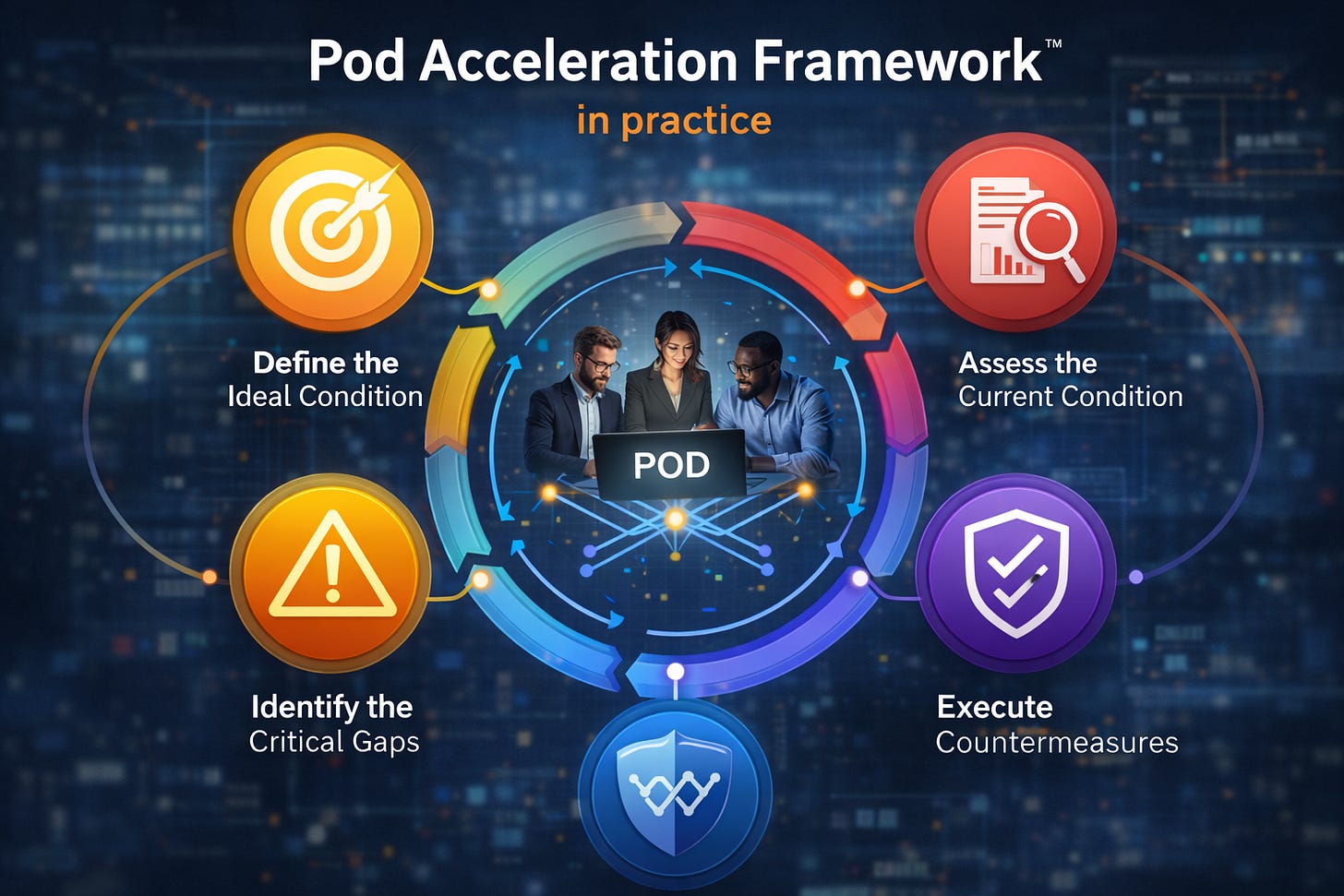
How the Pod Acceleration Framework™ works in practice
The model is simple enough to explain and disciplined enough to use.
Step 1: Define the Ideal Condition
Stat with the future state. Be specific. What problem are you solving. What result matters. What should be measurably better.
Step 2: Assess the Current Condition
Look at the real state of delivery. Where are the delays. Where are the handoffs. Where is ownership unclear. Where is governance slowing movement. Where is work getting stuck.
Step 3: Identify the critical gaps
Turn vague frustration into clear gaps. Not generic complaints. Not consulting wallpaper. Real barriers tied to delivery, cost, quality, speed, risk, or customer value.
Step 4: Analyze root causes
Do not stop at symptoms. Delays are not always a resource issue. Rework is not always a tooling issue. Slow delivery often comes from weak decision rights, fuzzy ownership, fragmented priorities, or governance that enters too late.
Step 5: Execute countermeasures in short cycles
Assign owners. Move fast. Learn quickly. Adjust based on evidence. Repeat.
That is where the Pod Acceleration Framework™ becomes useful. It helps teams move with urgency without becoming sloppy.
Why leaders should care now
Leaders do not need more AI theater. They need a system that matches the speed of the tools without losing control of quality, cost, or risk.
If the operating model is fragmented, AI will expose it. If priorities are unstable, AI will expose it. If nobody knows who owns a decision, AI will expose it. Faster output does not fix a broken system. It reveals the cracks sooner.
The real risk is not slow AI adoption
The real risk is using fast technology inside a slow, unclear, over layered operating model.
That is how companies end up with more pilots, more tools, more activity, and less value.
The real opportunity is operating model redesign
The organizations that win will not be the ones with the loudest AI narrative. They will be the ones that redesign execution, tighten learning loops, and give skilled professionals the structure to move fast without losing discipline.
What leaders should do next
Leaders should start with a few high value areas where delivery friction is obvious and speed matters.
Start small and prove the model
Pick a real business problem. Form a pod around it. Define the outcome. Clarify decision rights. Map the current condition honestly. Identify the real gaps. Then run the work in shorter cycles and measure what improves.
Build capability, not dependency
Do not rely on a handful of people to understand AI enabled delivery. Build capability across your professionals. The future will belong to organizations that develop this muscle broadly.
Measure the right things
Track cycle time, release frequency, quality, adoption, cost, and business impact. If the model is improving speed but damaging quality, fix it. If it is improving output but not outcomes, fix it.
The point is not speed for its own sake. The point is business performance.
Final thought
The future of work belongs to teams that can think clearly, solve problems quickly, and deliver in shorter, smarter cycles.
That is the point of the Pod Acceleration Framework™.
It is a modern operating model designed for a world where AI accelerates development, professionals master tools like Codex, Claude Code, and Spec Kit, and value is created by learning and releasing faster than traditional structures were built to handle.
If organizations keep trying to run AI through yesterday’s delivery machinery, they will keep getting the same result. More activity. More friction. More meetings. More confusion dressed up as transformation.
That trick is old. The operating model has to change.
The real barrier to AI is not access. It is structure.
Most teams do not need another pilot. They need a better way to work.
That is where the Pod Acceleration Framework™ matters. It helps teams move with urgency without becoming sloppy.
Now the real question:
What is slowing AI delivery more in your world right now...the toolset, the talent, or the operating model?
Subscribe if you want practical frameworks for building faster, smarter, AI enabled organizations without drowning in consulting nonsense.